Use case · Social listening
Dashboard previewSocial listening that keeps the evidence attached
Collect public conversation around a topic, group it by theme, and keep the posts that support each group available for review.
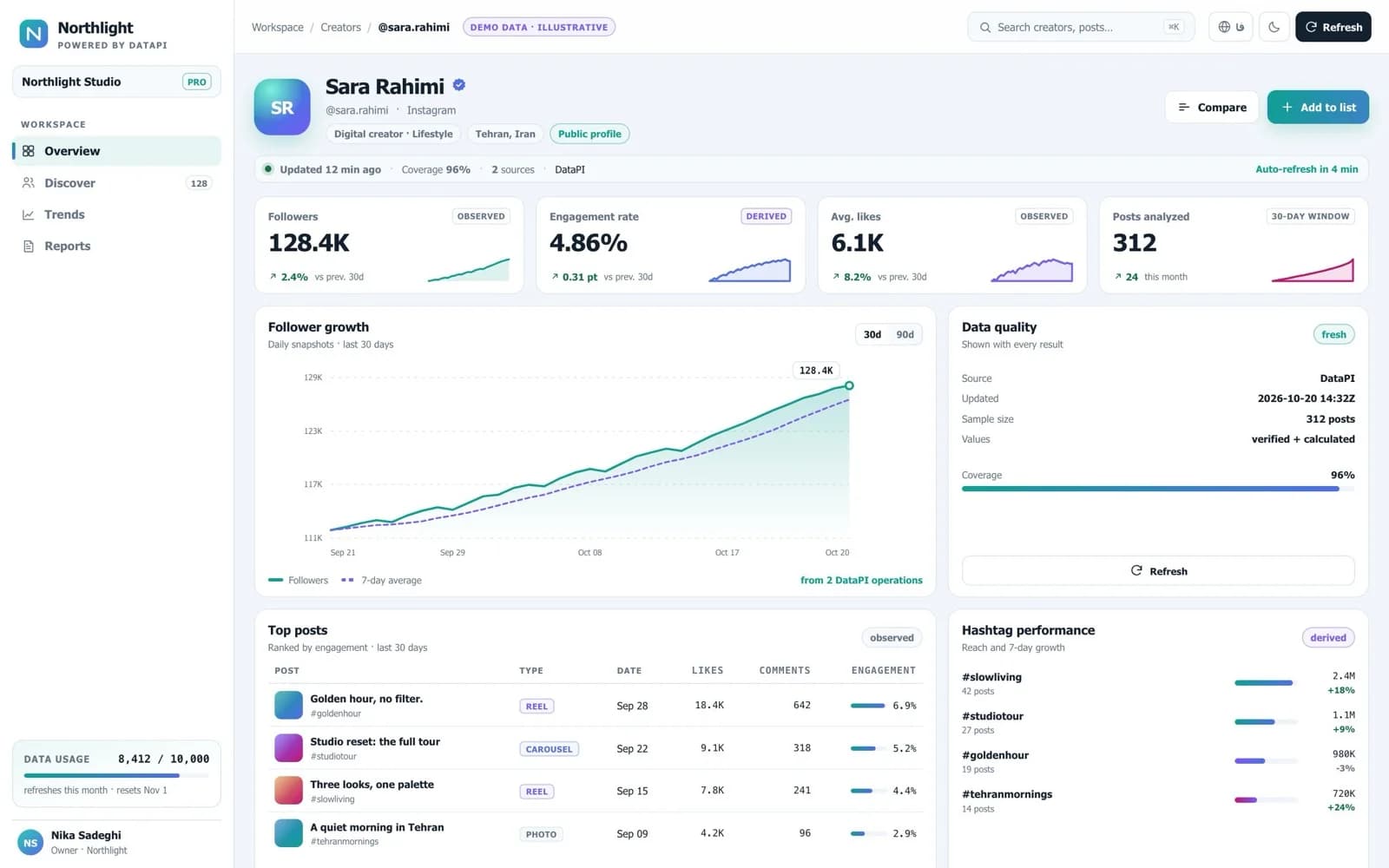
Illustrative example
Public posts observed
1,284
+12%
Median engagement
3.8%
+0.4 pt
Creators in shortlist
24
6 new
Coverage
partial
flagged
Observed posts per week
Illustrative series| Operation | Platform | Observed | Coverage |
|---|---|---|---|
| profile.posts | 2026-10-24 | complete | |
| hashtag.posts | 2026-10-23 | partial | |
| creator.search | TikTok | 2026-10-23 | complete |
| comment.thread | YouTube | 2026-10-22 | partial |
Illustrative data, not customer results
Listening tools are good at counting and vague about meaning
- Insights and research teams.
- Community and social teams.
A volume chart answers “how much?” and leaves “about what?” to the reader. Manually reading hundreds of posts is the step most teams skip when time is short.
Grouping by theme, with the evidence retained, makes the qualitative step reviewable. A colleague can disagree with a grouping by opening the rows behind it.
Capabilities
Where this topic leads
Follow the relationship that matches the question you are trying to answer.
How it works
- 01
Define the query
Write the topic, market and exclusions before collecting anything.
- 02
Group and challenge
Build themes, then read a sample of posts to test whether the grouping holds.
- 03
Report with limits
Present themes with counts, quotes and an explicit note on what public data cannot tell you.
What changes for your team
- Qualitative findings that can be audited.
- Faster synthesis of large conversation sets.
- Honest reporting about representativeness.
- Public conversation is not a representative sample of any population.
- Theme assignment is a judgement, whether made by a person or a classifier.
Frequently asked questions
Monitoring tracks a defined set of subjects for change; listening explores an open topic to understand meaning. Most teams need both, for different questions.
The API and analytics behind this use case
Each metric family links to its definition, formula and limit in the glossary, and each endpoint to its contract page. These are the paths this workflow actually travels.
Metric families
Related pages
- Research: study markets through public conversationBy goal
- For marketing teams that must defend a planSolutions
- Hashtag co-occurrence for topic mappingFeatures
- Brand monitoring that shows what changed, not just a scoreUse cases
- Customer feedback analysis from public commentsUse cases
- Social Intelligence workspaceProducts
Run one operation and check the coverage
Sign in with a one-time code, create a credential and call the catalog. Plans are monthly, and there is no checkout on this site.