Service · Dashboard preview
Research: study markets through public conversation
Explore public discussion by topic, hashtag, content format and period to build hypotheses you can test, and to see what the data cannot tell you.
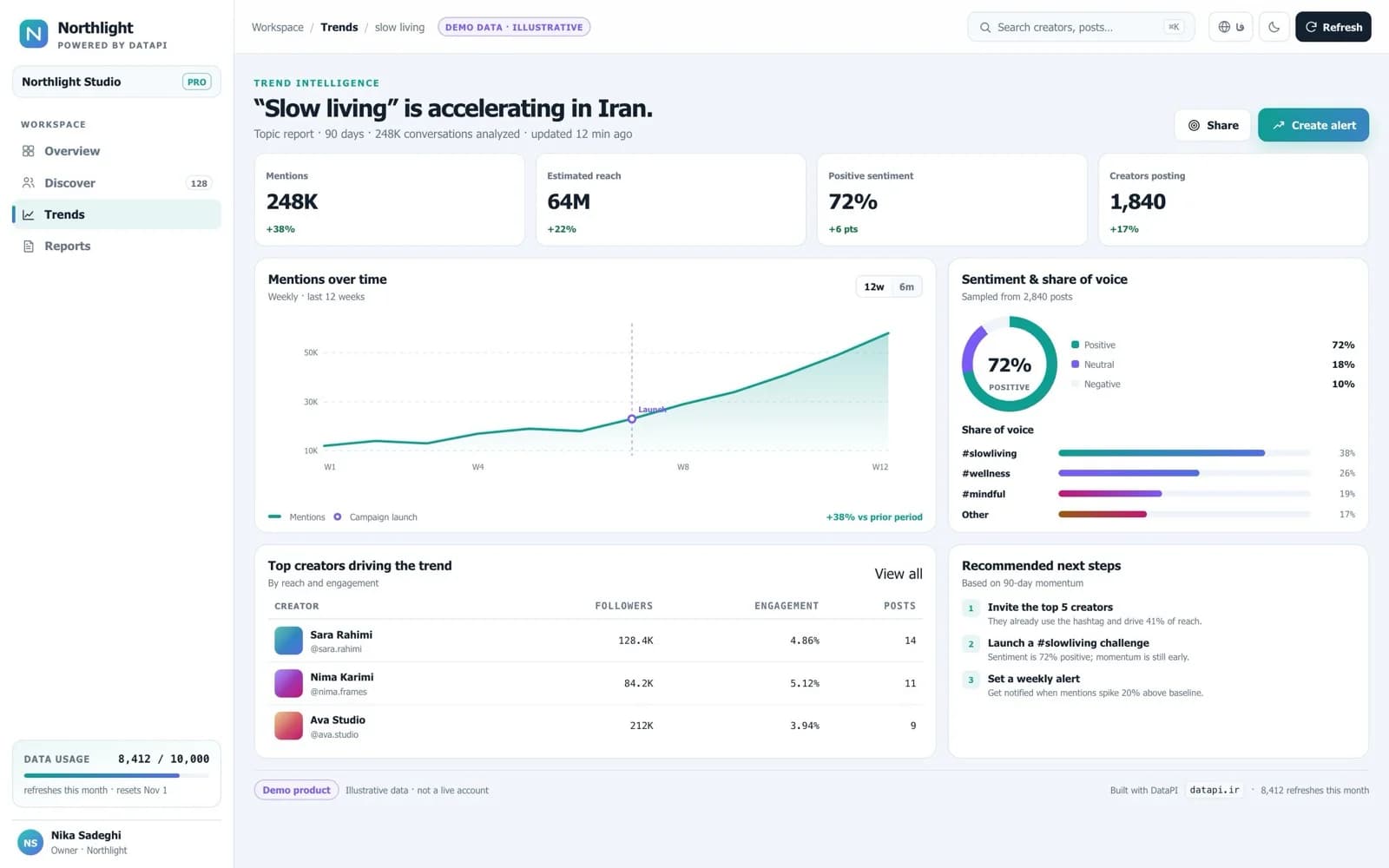
Survey answers are late and expensive; posts are early and uneven
- Market research and insight teams.
- Strategy teams entering a category.
A survey tells you what a sample says when you ask. Public conversation tells you what people already chose to discuss, which is earlier and cheaper but unrepresentative.
Research here is built for that trade-off: you get breadth and recency, and the method states where representativeness ends.
Capabilities
Where this topic leads
Follow the relationship that matches the question you are trying to answer.
How it works
- 01
Frame the question
Write the decision the research should inform and the population it concerns.
- 02
Triangulate
Combine public signals with surveys, sales data or interviews before concluding.
What changes for your team
- Earlier hypotheses with visible provenance.
- A cheaper first pass before commissioning fieldwork.
- Clear language about what remains uncertain.
- Public posts are not a representative sample of any population.
- Volume changes can reflect platform distribution or moderation, not only public interest.
Frequently asked questions
No. It is a complementary, non-representative source. Use it to form hypotheses and to design better survey questions.
Related pages
- Social Intelligence workspaceProducts
- Market research that starts earlier and admits its sampleUse cases
- Social listening that keeps the evidence attachedUse cases
- Analyze: turn collected content into reviewable findingsBy goal
- Track: know what changed since the last checkBy goal
- Discover: find the right creators and conversationsBy goal
Run one operation and check the coverage
Sign in with a one-time code, create a credential and call the catalog. Plans are monthly, and there is no checkout on this site.