Use case · Influencer marketing
Dashboard previewInfluencer shortlists built on evidence, not follower count
Turn a campaign brief into a shortlist where every creator has a documented reason, a content check and a known gap.
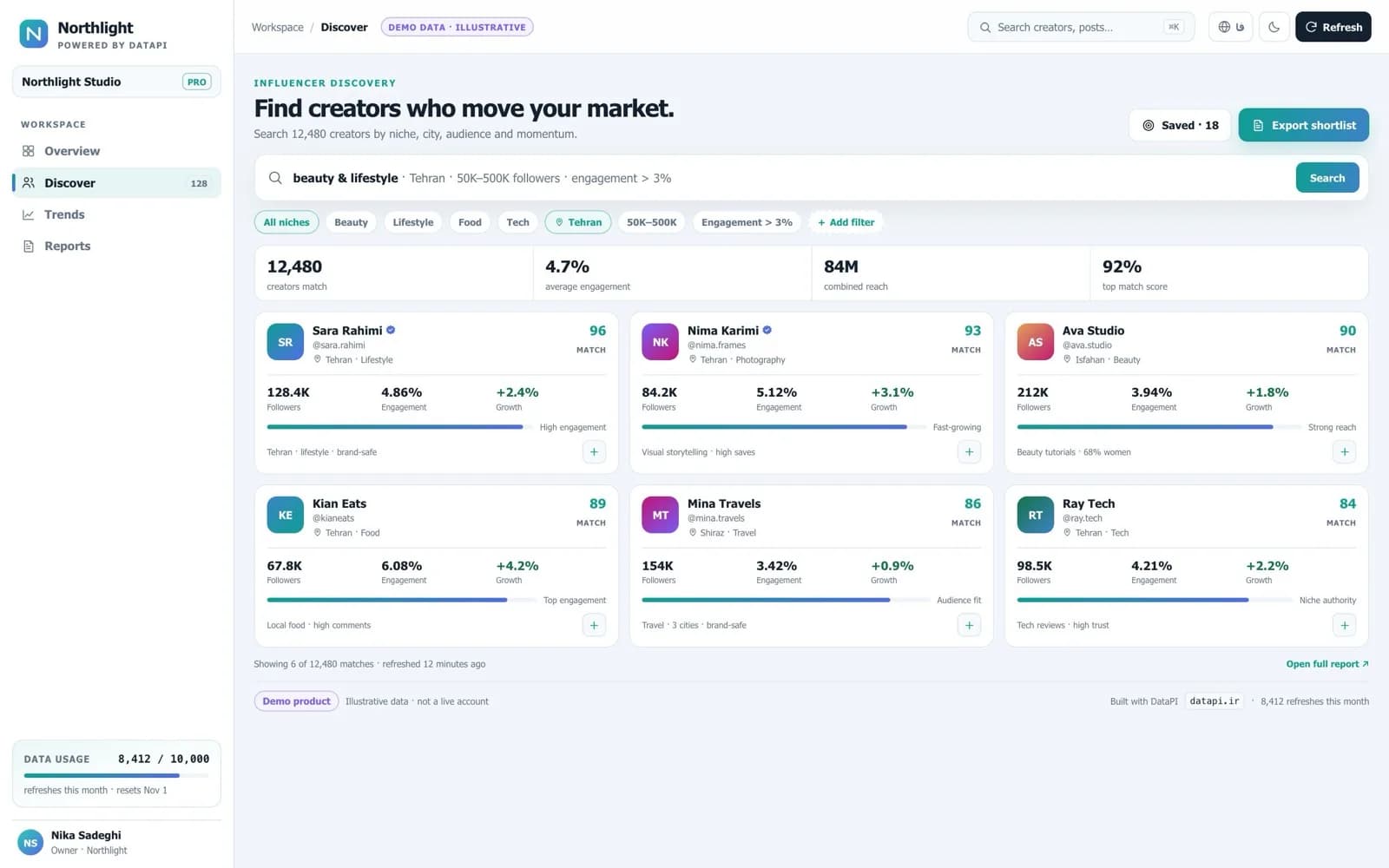
Illustrative example
Brief: skincare · market: Iran · format: short video · window: 60 days
| Creator | Fit topics | Posts reviewed | Median engagement | Audience check | Decision |
|---|---|---|---|---|---|
| creator.a | routine, ingredient | 18 | 4.1% | with creator | Shortlist |
| creator.b | makeup, routine | 11 | 6.8% | unverified | Hold |
| creator.c | unboxing | 9 | 2.4% | with creator | Exclude |
Stated gaps
- creator.a — Audience detail must be confirmed with the creator.
- creator.b — Engagement spike on two posts; check distribution before ranking.
- creator.c — Topical fit is weak even though reach is high.
Every row keeps a collection date and a stated gap. A finalist is validated with the creator; the platform does not score people as a single truth.
The long list is cheap; the decision is expensive
- Influencer marketing teams.
- Brand and agency planners.
Sorting by followers produces the same shortlist for every brand in a category. The differentiating work — does this person actually publish relevant content for this market — is still manual.
A documented shortlist changes the conversation from “who is big?” to “who fits, and what is the evidence?” That is the question a client or brand owner can review.
Capabilities
Where this topic leads
Follow the relationship that matches the question you are trying to answer.
How it works
- 01
Write the brief
Market, topic, audience, objective and non-negotiable brand criteria.
- 02
Collect candidates
Search public profiles and recent content, then remove weak topical fits.
- 03
Compare and validate
Compare finalists on identical fields, then confirm audience detail with the creator.
What changes for your team
- A shortlist a client can review.
- Less manual profile reading.
- Clear separation of evidence and judgement.
- Public data cannot confirm audience demographics, purchase intent or conversions.
- Engagement figures can be inflated by bots, pods or paid distribution.
- Performance is measured after the campaign with campaign-side data.
Frequently asked questions
No. It organizes public evidence for a human decision. Results depend on creative, offer, audience and timing.
The catalog lists operations for several platforms, but coverage depends on which source mappings are qualified and available in your workspace.
The API and analytics behind this use case
Each metric family links to its definition, formula and limit in the glossary, and each endpoint to its contract page. These are the paths this workflow actually travels.
Metric families
Related pages
- Creator discovery and comparisonProducts
- Discover: find the right creators and conversationsBy goal
- For influencer agencies that must justify a shortlistSolutions
- Build advertising messages from what people already discussUse cases
- Brand monitoring that shows what changed, not just a scoreUse cases
- DataPI APIProducts
Run one operation and check the coverage
Sign in with a one-time code, create a credential and call the catalog. Plans are monthly, and there is no checkout on this site.