The DataPI learning library
Know what the number means
Plain-language guides to metric goals, formulas, inputs and limitations, connected to the exact supported metric IDs and API references. Availability is checked separately.
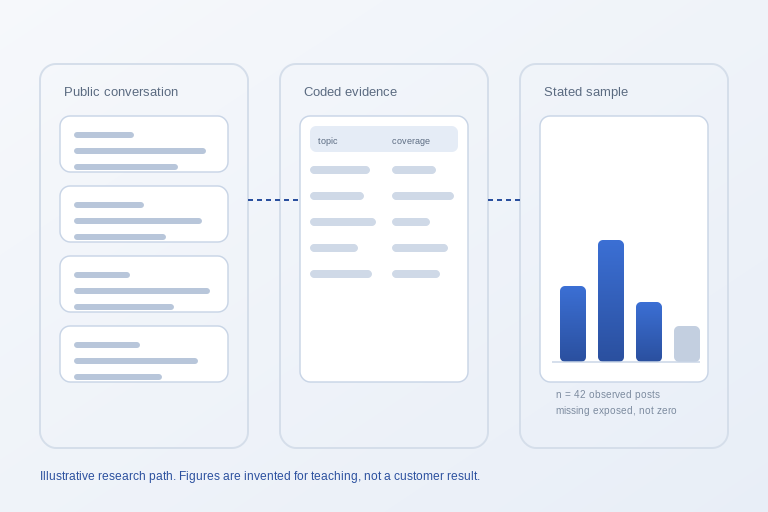
Start from your question
Metric
Engagement rate: which denominator are you quoting?
Four different fractions are all called "engagement rate". This guide shows how to pick one, name it in the report, and keep comparisons honest.
Metric
Posting frequency: reading cadence as a habit
Cadence explains more of an engagement total than most teams expect. Learn to count posts per week without rewarding volume for its own sake.
Metric
Views and reach: what a view does not tell you
A view is an exposure event, not a person. Separate views, unique viewers and followers before you report reach to anyone.
Metric
Medians and outliers: why the average hides the post
One widely shared post can carry an account average on its own. Use the median, the quartiles and the zero-engagement share instead.
Metric
Sentiment shares: a model estimate, not a mood
Positive, negative and unclassified are three different things. Read sentiment as shares with the unknown bucket visible.
Metric
Is this a trend? Testing topic growth before you act
A rising hashtag count can be one account, one event or one bad query. Four checks separate a trend from a spike.
Metric
Share of voice: a ratio that needs a stated universe
Share of voice is a fraction of mentions inside a defined query. Change the query and the share changes. Here is how to keep it comparable.
Metric
Creator comparison: scoring finalists on identical fields
A weighted creator score is an opinion with arithmetic attached. Compare finalists on fixed fields, then record the judgement separately.
Metric
Coverage checks: know the sample before the number
Every metric rests on a sample. Four coverage fields tell you whether the sample can carry the claim you are about to make.
Metric
Follower growth: change, rate, and what neither proves
Growth needs two observations taken the same way. Absolute change, percent change and daily velocity answer different questions about the same account.
Metric
Campaign lift: separating a change from noise
Lift is a difference between two periods. Without a comparable baseline, the same chart can describe a campaign, a holiday or a collection change.
Metric
Which metric answers my question? A routing guide
Start from the decision you must make, not from the metric list. Six question types, the family each maps to, and the checks before you report an answer.
Metric families and information
Metric family
Profile and audience signals
Understand account size and change without confusing public follower counts with the people who saw a post.
Metric family
Content performance and publishing cadence
Compare the typical public response to content while accounting for age, format, and the size of the observed sample.
Metric family
Engagement distribution and outliers
Find whether performance is shared across many posts or concentrated in a few unusually popular items.
Metric family
Comments, questions, and sentiment
Turn an observed discussion into themes and review priorities while keeping sentiment estimates separate from customer facts.
Metric family
Topics, hashtags, and changing attention
Track how a defined topic changes in an observed sample, and distinguish rising attention from a change in the query.
Metric family
Creator discovery and evidence-led shortlists
Compare candidate creators on relevance and observable evidence instead of treating one score as a hiring decision.
Metric family
Campaign-scoped public signals
Measure a deliberately defined campaign sample without implying attribution, paid reach, or conversion data.
Metric family
Coverage, freshness, and data quality
Decide whether a result is strong enough for the intended decision before interpreting its headline number.
Metric family
Cross-platform comparisons: preserve meaning
Understand why differently defined public counters cannot automatically be pooled into one audience or engagement total.
Metric family
Private audience metrics and public-data limits
Know which questions require an account owner, a consented first-party source, or a separately disclosed estimate.
Metric family
TikTok public video metrics
Compare observed video activity while separating plays, interactions, and unavailable follower history.
Metric family
YouTube public channel and video metrics
Read channel scale, video views, and visible response without claiming private retention or subscriber conversion.
Metric family
X public posts and conversation metrics
Separate posting volume, replies, and redistributed content when examining a fast-moving public conversation.
Metric family
LinkedIn public professional-content metrics
Use public professional conversation as qualitative and comparative evidence, with format-specific view availability.
Metric family
Telegram public-channel observations
Read public-channel views, reactions, and subscribers as separate signals with explicit observation times.